











 Global Hotline
What is Touchscreen Glare?
Touchscreen glare refers to the specular reflection of ambient light on a display surface, where external light overlaps with on-screen content, reducing contrast and readability.
In industrial touchscreens, medical displays, and HMI systems, glare can directly impact information recognition, operational efficiency, and system safety. Therefore, glare control has become a critical factor in industrial display design.
An Overlooked Everyday Industrial Problem
In industrial and professional environments, touchscreens and industrial displays have become the core human-machine interface.
Whether in medical equipment, industrial control systems (HMI), automation equipment, or outdoor terminals,
displays are not only used to present information, but also directly influence decision-making and operational accuracy.
However, in real-world environments, one issue consistently appears:
- Medical displays suffer from glare under strong surgical lighting, affecting image detail recognition
- Industrial touchscreens experience reflection and glare under factory lighting conditions
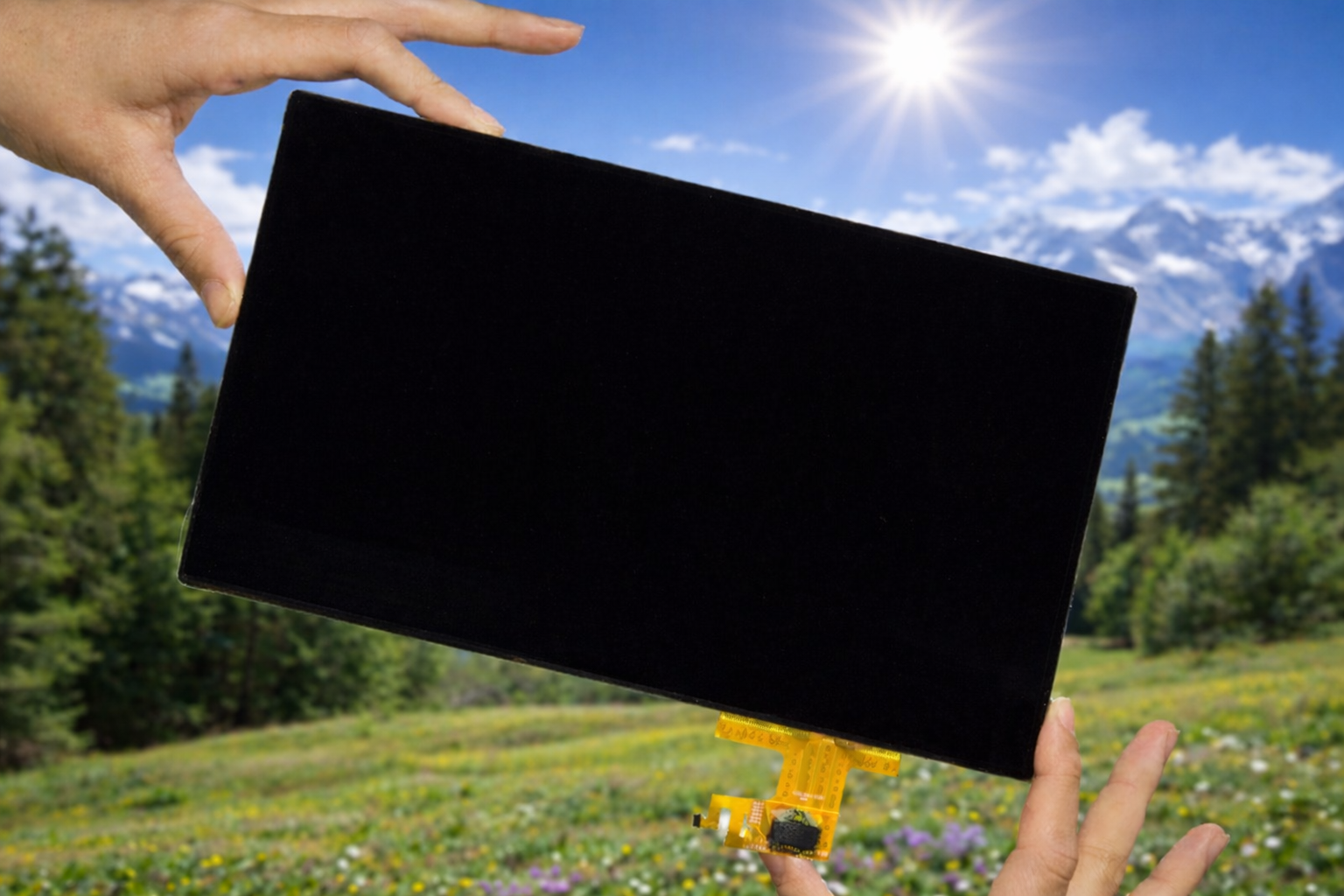
- Outdoor displays become difficult to read under direct sunlight
These issues are often mistaken for insufficient brightness.
But in reality, the root cause is:
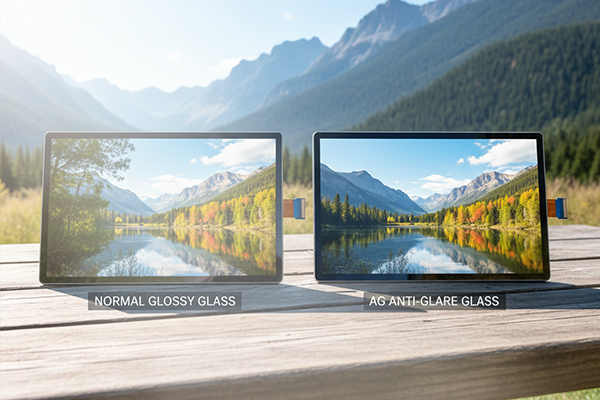
Touchscreen glare leading to reduced display readability.
Therefore, in complex lighting environments, glare control is more important than simply increasing brightness.
Why Are Industrial Touchscreens More Prone to Glare?
Industrial touchscreens typically adopt a multi-layer structure, including:
- Cover Glass
- Touch Panel
- Display Panel
To ensure high clarity, these materials are designed with high transmittance.
However, this also results in higher reflectance.
When ambient light hits the display surface, the glass layer creates specular reflection,
interfering with the user’s ability to clearly see the screen content.
As a result, high transparency and glare are inherently linked.
Why Increasing Brightness Does Not Solve Glare
In industrial displays, increasing brightness (high brightness display) does not fundamentally solve glare issues, because:
- Display content overlaps with reflected light
- Effective contrast is reduced (contrast loss)
- Visibility remains poor under strong light conditions
Brightness enhancement can only “boost the signal,” but cannot “eliminate the interference.”
Therefore, under sunlight or strong lighting conditions,
the key factor affecting readability is reflectance, not brightness.
Three Major Impacts of Glare on Industrial Touchscreens
1. Reduced Display Readability
In medical imaging displays, subtle visual differences are critical for diagnosis.
In industrial HMI systems, parameters and status information must be recognized quickly and accurately.
Glare can lead to:
- Reduced contrast
- Loss of image detail
- Increased difficulty in reading information
As a result, glare directly affects information accuracy and operational safety.
2. Reduced Operational Efficiency
When glare is present on a touchscreen, operators often need to:
- Adjust viewing angles
- Change their posture
- Reconfirm information multiple times
In high-frequency environments such as production lines or control rooms,
these small adjustments accumulate into measurable efficiency losses.
3. Increased Visual Fatigue
Industrial displays are often used for extended periods.
Glare increases visual strain by forcing the eyes to constantly adjust between content and reflected light, leading to:
- Faster onset of eye fatigue
- Reduced concentration
- Decreased long-term comfort
This can negatively impact operational stability in both industrial and medical environments.
How to Reduce Glare on Industrial Touchscreens
Common glare reduction technologies in industrial displays include:
- Anti-Reflection (AR coating)
- Anti-Glare (AG treatment)
- Optical Bonding
- Low Reflection Glass
The primary goal of these technologies is:
To reduce reflectance and improve readability in complex lighting conditions.
As a result, industrial display optimization is shifting from “increasing brightness” to “reducing glare.”
What Is the Difference Between Anti-Glare and Anti-Reflection?
These two technologies are often confused in industrial touchscreen design:
- Anti-Glare (AG): Reduces harsh reflections by diffusing light, but may slightly reduce image clarity
- Anti-Reflection (AR): Reduces reflectance to improve contrast and image clarity
In practice, both are often combined to balance readability and visual quality.
Therefore, the optimal solution depends on the specific application scenario.
Display Requirements in Industrial Applications
In medical devices, industrial automation (HMI), and outdoor equipment, displays typically need to meet the following requirements:
- High readability
- Low reflectance
- Stable contrast
- Sunlight readable display performance
Therefore, glare control has become a key metric in industrial display design.

KANOU Display: Towards a World Without Screen Glare
As industrial display technology evolves, the industry is shifting from specification-driven design to real-world usability.
KANOU Display focuses on glare reduction and display optimization for industrial touchscreens, aiming to improve readability in complex lighting environments.
Compared to simply increasing brightness, reducing reflectance provides a more effective solution.
“Towards a world without screen glare” represents a clear direction:
- Maintain readability under strong lighting conditions
- Ensure stable display performance in complex environments
- Reduce the need for user adjustment
- Improve overall human-machine interaction efficiency
As a result, reducing touchscreen glare is becoming a key factor in improving performance across industrial, medical, and smart device applications.
FAQ
How can glare on industrial touchscreens be reduced?
Glare can be reduced using anti-reflection coatings (AR), anti-glare treatments (AG), optical bonding, and low reflection glass.
Why is my screen hard to read in sunlight?
A sunlight readable display requires both high brightness and low reflectance through anti-reflection technologies.
What is a sunlight readable display?
It refers to a display that maintains high readability under strong ambient light or direct sunlight, typically achieved through high brightness and glare reduction technologies.
What is the function of optical bonding?
Optical bonding reduces internal reflections by eliminating air gaps, improving contrast, durability, and overall display performance.
E-mail:raymond.chew@kanouprecision.com
Add:12 Woodlands Square #09-76,Woods Square Tower 1,Singapore 737715
Factory Add:No.46 Hongfeng Road, Chang'an Town
Dongguan City, Guangdong, China